
Beginner's Guide to Journaling for Self-Care: What to Write When You Feel Stuck
Blank page. Pen in hand. Four minutes gone and nothing written. If that sounds familiar, you are not bad at journaling — you have probably just been given the wrong instructions. Most advice assumes you already know what you want to say and simply need a nice notebook to say it in. The hard part is the first line. This is a guide for that bit: what to write when your head is empty, noisy, or full of things you would rather not look at.
What journaling actually does for your wellbeing
A journal is not a cure and it is not a personality trait. It is a tool, and like most tools it works best when the job is small and specific.
The main thing it does is move a thought out of the loop in your head and onto a page, where it has edges. A worry that circles for three hours often shrinks to one sentence once it is written down. That sentence might still be true and still be annoying, but at least you can see it.
The second thing it does is remember for you. Patterns that are invisible day to day become obvious across a month — that your energy dips every Sunday evening, that a particular friendship leaves you flat, that you sleep badly the nights you answer work emails late. You cannot spot a pattern from inside a single day.
And it gives you somewhere to be honest without managing anyone's reaction. That is rarer than it sounds.
One sensible note: if you are dealing with persistent low mood, anxiety or anything that frightens you, a notebook is a useful companion but not a substitute for proper support. Speak to your GP or a qualified professional.
The only rules worth keeping
Almost everything else is preference. These four are worth holding on to:
- Keep it short. Three minutes counts. One sentence counts.
- Keep it private. No audience means no performance. If you share a home, a drawer is enough.
- Keep it messy. Crossings out, half-sentences, bullet points, a shopping list in the middle. Nothing here is being marked.
- Don't reread straight away. Give an entry a week or a month before you look back. Reading a raw entry the same evening mostly invites cringing.
Simple prompts for when you feel stuck
Being stuck usually means one of four things: you are tired, your mind is racing, something is raw, or you genuinely don't know what you feel. Match the prompt to the mood rather than forcing the same one every time.
If you are tired or flat
- What was one thing that felt slightly easier than expected today?
- What did I do in the last twenty-four hours that was only for me?
- What am I glad is over?
If your mind is racing
Forget sentences. Set a timer for five minutes and write a brain dump — every task, worry, half-thought and name that surfaces, in whatever order it arrives. The aim is to empty the surface layer so you can see what is underneath. Anything that is genuinely a task can be circled and moved to a to-do list afterwards.
If something is bothering you
Try two questions in this order. First: what am I actually afraid of here? Then: what is the smallest next step, even if it is tiny? The second question is the one that stops a journal entry becoming a rehearsal of the same complaint.
If you don't know what you feel
Describe the last hour as if you were a camera on the ceiling. Facts only: where you sat, what you did, what you said, how your shoulders felt. Feelings often turn up halfway through describing the scene. You can also borrow a word list — tired, restless, heavy, flat, wired, tender — and pick whichever is least wrong.
Five low-pressure formats to try
- The one-sentence entry. One line about the day, no more. "Went to the shops, felt better afterwards." That is a complete entry.
- The three-line check-in. One thing that happened. One thing I felt. One thing I want tomorrow. Three lines, every time, same order. Repetition makes it fast, and speed is what keeps it going.
- The list entry. Lists only. Things I am avoiding. Things that helped this week. Things I would say if I were braver. A page of lists is still a page of thinking.
- The unsent letter. Write to a person, a past version of yourself, or a situation. Write it knowing it will not be sent. This is often where the honest version shows up.
- The two-column page. On the left, what is within my control. On the right, what is not. Most of the right-hand column can be left alone for now, and that alone takes weight off.
When resistance shows up
Resistance rarely means the practice is wrong for you. It usually means one of three things: you are aiming too high, you are comparing your notebook to someone else's finished, colour-coded pages, or you are trying to process something heavy on a day with no capacity for it.
Lower the bar until you would still do it on a bad day. One sentence is the bar. If you miss four days, that is not a broken streak, because there is no streak — there is just a notebook on a shelf, waiting, with no opinion about how long you have been away.
Making it easy to come back
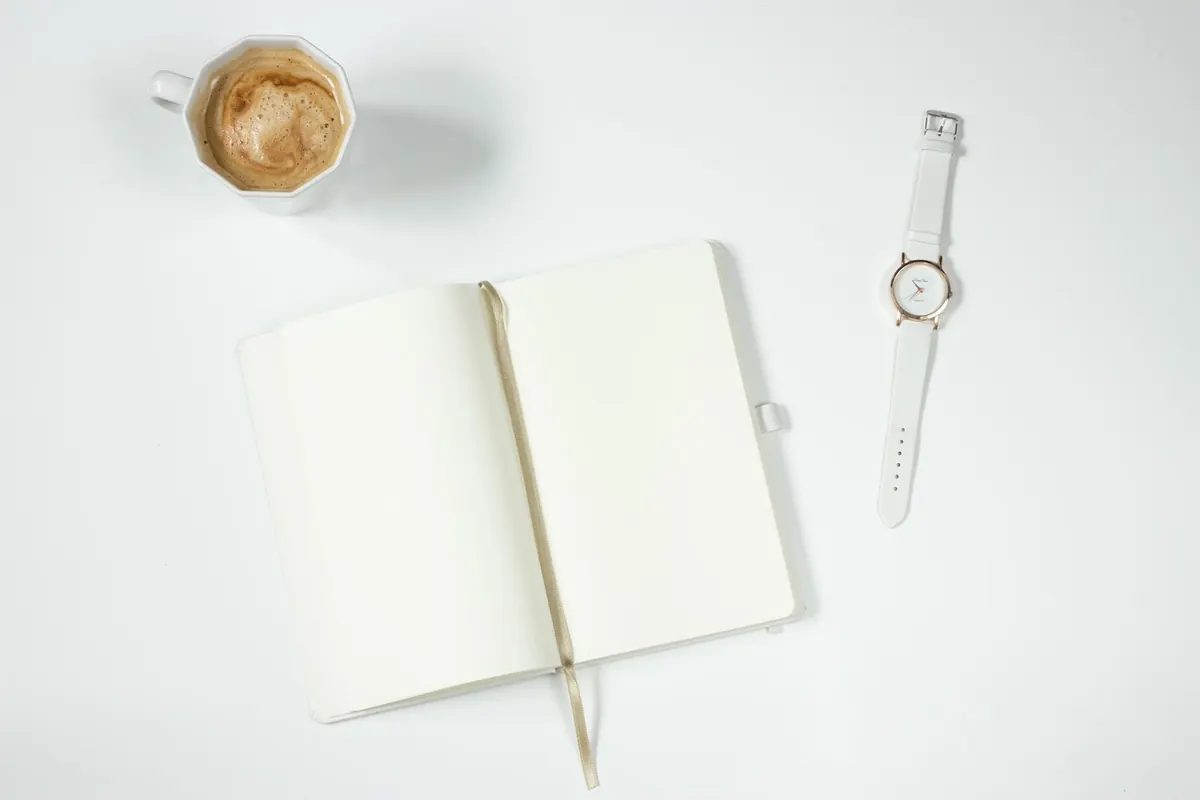
Habit research is clear that convenience beats motivation, so make the practical side almost embarrassingly easy. Keep the notebook open, or the pen resting on it, somewhere you already sit — the kitchen table, the bedside, the bag you take to work. Attach the writing to something you already do without thinking: the kettle boiling, the train journey, the last ten minutes before lights out. Put a two-minute timer on your phone if a blank page makes you sprawl.
Then decide your minimum in advance. Something like: one sentence, most evenings, and a longer entry when there is something worth saying. A rule that small is one you can keep when you are ill, busy or bored of the whole idea.
A short check-in you can use tonight
If you want somewhere to start, try this four-step check-in. It takes about five minutes.
- Write the date and one word for how the day felt.
- Write one thing you did that you would do again.
- Write one thing you would handle differently, without explaining why.
- Write one thing you want tomorrow to include.
Close the book. That is the whole practice. Tomorrow, if you feel like it, do it again.
Photo: Fotownetrza / Pixabay